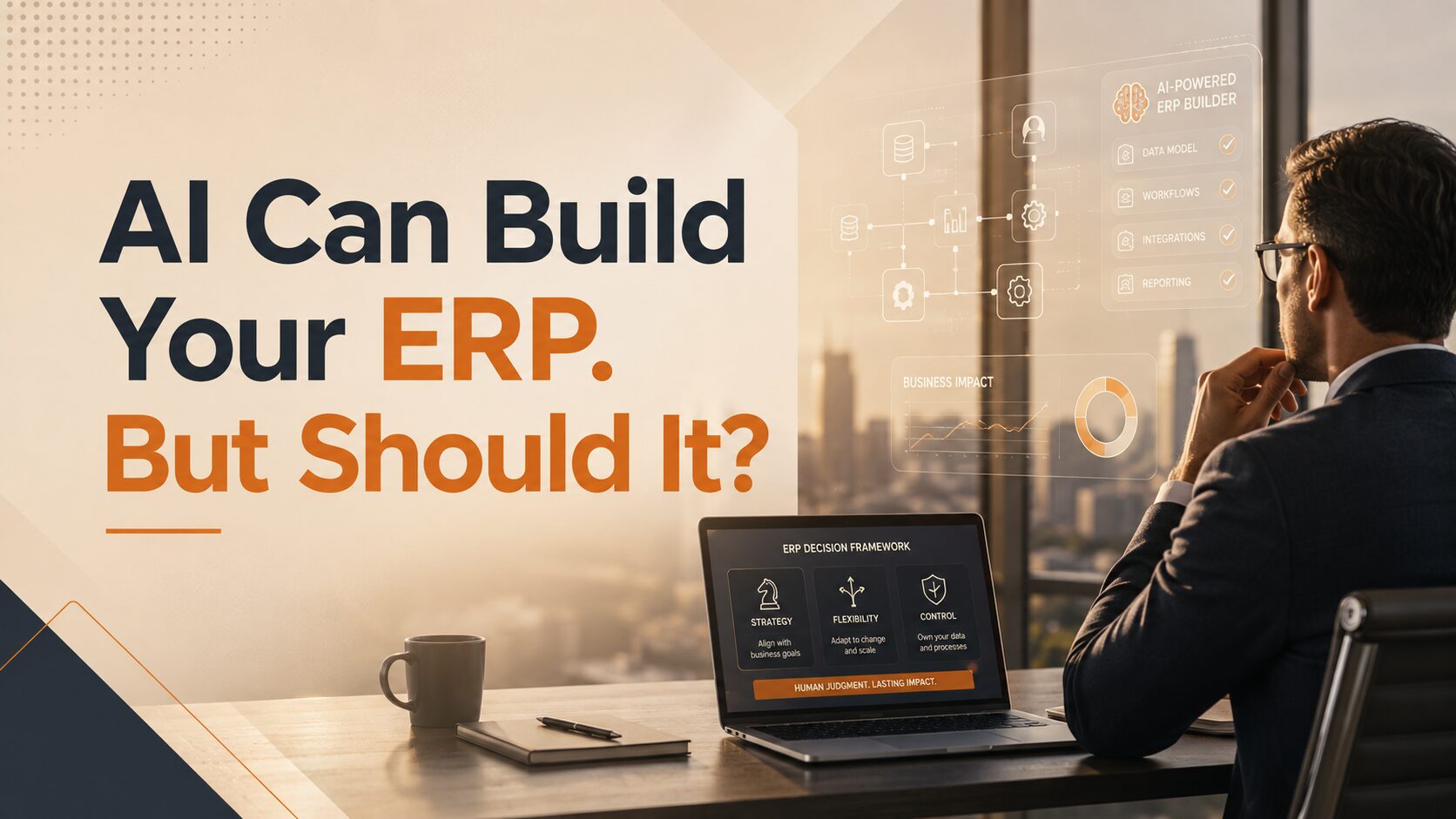
AI Can Build Your ERP. But Should It?
Artificial intelligence is changing the way business software is built.
What previously required months of development, large technical teams and significant budgets can now sometimes be prototyped in days or weeks. AI-assisted coding tools can generate applications, workflows, dashboards, integrations and even fairly complex business systems much faster than before.
This naturally raises a question we are beginning to hear more often from business owners and technology teams:
“If AI can build our own ERP, why should we still buy an established ERP platform?”
It is a very reasonable question.
And the answer is no longer as simple as saying that traditional ERP is better.
The real question businesses should be asking is:
What should we build ourselves, and what should we standardise on an established platform?
📌 Key Takeaways
- AI has changed the economics: building custom applications is faster and cheaper than it has ever been.
- Building is not operating: a prototype is quick; governance, audit trails, and compliance over ten years are not.
- Think 80/20: standardise the common core (accounting, AR/AP, inventory, tax) and build where your business is genuinely different.
- The real question: not “can AI build it?” but “should we own and maintain it for the next five to ten years?”
Table of Contents
- AI Has Changed the Economics of Software Development
- Building an Application Is Different From Operating an ERP
- The Question Is Not “Can AI Build It?”
- Think 80/20: Standardise the Core, Innovate Where It Matters
- The Hybrid Model: ERP + AI + Custom Applications
- Where Platforms Like NetSuite Fit
- When Building Your Own System May Make Sense
- When an Established ERP Becomes More Important
- AI and ERP Are Not Competitors
- Before You Decide to Build Your Own ERP
- Frequently Asked Questions
AI Has Changed the Economics of Software Development
AI has significantly reduced the effort required to build software.
Companies can now develop:
- Customer portals
- Mobile applications
- Approval workflows
- AI agents
- Reporting tools
- Industry-specific applications
- Integration services
- Internal productivity applications
faster than ever before.
For organizations with capable internal technology teams, this creates exciting opportunities.
Processes that previously had to fit within the limitations of packaged software can now be customized more easily.
But building software faster does not necessarily mean every business system should be built from scratch.
Building an Application Is Different From Operating an ERP
A prototype can look impressive very quickly.
The bigger challenge starts after the system goes live.
An ERP is not simply a collection of screens and workflows. It sits at the centre of critical business processes such as:
- Financial accounting
- Accounts receivable
- Accounts payable
- Procurement
- Inventory
- Sales orders
- Tax
- Financial closing
- Multi-company operations
- Multi-currency transactions
- Consolidation
- Approval controls
- Audit trails
For these areas, businesses need to think beyond development speed.
They also need to consider governance, data integrity, security, compliance, scalability and long-term maintenance.
The Question Is Not “Can AI Build It?”
In many cases, the answer is yes.
AI can probably help build a significant portion of the system.
A better question is:
Should your organization own and maintain it for the next five or ten years?
Before deciding to build a core business system internally, management should consider several questions.
Who will maintain the architecture and code when the original development team changes?
Who validates the accounting logic?
How will segregation of duties be enforced?
How will audit trails be maintained?
Who updates the system when tax or regulatory requirements change?
What happens when transaction volume grows five or ten times?
How will multiple companies, currencies and countries be supported?
How will development, testing, UAT, deployment and rollback be governed?
And perhaps most importantly:
Who is accountable if the system produces incorrect financial information?
These are not arguments against AI.
They are questions about long-term system ownership.
Think 80/20: Standardize the Core, Innovate Where It Matters
For many businesses, the best answer may not be to choose between AI and ERP at all.
A more practical architecture is to divide requirements into two categories.
The 80%: Standard Business Processes
Most companies need similar capabilities for:
- Accounting
- Procurement
- Inventory
- Accounts receivable
- Accounts payable
- Order management
- Financial reporting
- Tax
- Audit controls
- Consolidation
- User permissions
These areas are important, but they usually do not differentiate one company from another.
Rebuilding all of them internally may consume significant development and maintenance resources without creating competitive advantage.
The 20%: What Makes Your Business Different
This is where custom development and AI can create much more value.
Examples include:
- Unique customer experiences
- Industry-specific workflows
- Special pricing models
- AI agents
- Custom portals
- Special operational applications
- Proprietary processes
- New digital services
This is where internal development teams should often focus their energy.
Instead of rebuilding accounting, inventory and financial controls, they can concentrate on technology that genuinely differentiates the business.
The Hybrid Model: ERP + AI + Custom Applications
For many organisations, the future architecture may look like this:
AI, Agents and Custom Applications
connected through
APIs, Integrations and Workflow Automation
into
an established ERP system of record
The ERP provides the transactional foundation.
AI and custom applications provide flexibility and innovation.
This allows businesses to benefit from both worlds.
They gain the stability, governance and financial controls of an enterprise platform while retaining the flexibility to innovate around it.
Where Platforms Like NetSuite Fit
A platform such as Oracle NetSuite can serve as the system of record for core business operations including finance, procurement, inventory, order management, consolidation and reporting.
AI and custom applications can then sit around that core platform.
For example, a company may decide to build its own AI-powered customer portal while using NetSuite for financial processing.
Another company may develop industry-specific operational software internally while maintaining accounting, purchasing and inventory within NetSuite.
The objective is not to force every process into the ERP.
The objective is to determine which processes should be standardized and which should remain flexible.
When Building Your Own System May Make Sense
There are situations where an AI-first or custom-built approach may be appropriate.
For example, when a company has:
- A strong permanent development organization
- Highly unique business processes
- Low accounting complexity
- Strong technology governance
- A strategic reason to own the application
- A business model where software itself provides competitive advantage
In these situations, building more of the platform internally may be justified.
However, companies should still evaluate the total lifecycle cost rather than only the initial development cost.
This includes:
- Internal developers
- Infrastructure
- Security
- Testing
- Documentation
- Maintenance
- Regulatory updates
- Bug fixing
- Integration maintenance
- User support
- Business continuity
- Technical debt
AI may dramatically reduce development cost.
It does not eliminate system ownership.
When an Established ERP Becomes More Important
The case for an established ERP typically becomes stronger as organizations become more complex.
Examples include companies with:
- Multiple subsidiaries
- Multiple countries
- Multiple currencies
- Complex accounting requirements
- High transaction volumes
- External investors
- Strong governance requirements
- Regulatory obligations
- Regional expansion plans
- IPO ambitions
At this stage, management often needs more than software functionality.
They need a reliable business platform with established controls and governance.
AI and ERP Are Not Competitors
The most important change in thinking is this:
Businesses no longer need to choose between AI and ERP.
AI is an innovation layer.
ERP is a transactional foundation.
Used correctly, they complement each other.
At iDynamics, our view is that companies should use AI aggressively where it creates competitive advantage, while standardising core financial and operational processes where appropriate.
The future of enterprise systems is likely to be increasingly hybrid.
Companies will own more specialised applications.
AI will automate more processes.
But strong systems of record will continue to play an important role in maintaining financial integrity, governance and operational control.
Before You Decide to Build Your Own ERP
Ask one final question:
If AI can build the system, should your company also own the responsibility of maintaining, governing and supporting it for the next decade?
The answer will be different for every organization.
The right decision may be to build.
It may be to buy.
Or increasingly, it may be to combine both.
At iDynamics, we help organizations evaluate these options and design the right architecture around their business requirements — whether that means NetSuite, custom applications, AI or a combination of all three.
Standardise the core.
Build where it counts.
Not sure which parts of your operation belong on an established ERP and which are worth building yourself? Talk it through with our team — no pitch, just a straight read on your setup.
Where the work sits
Standard core — 80%
Custom & differentiating — 20%
Governed by one system of record
Frequently Asked Questions
Can AI actually build an ERP system?
In many cases AI can build a significant portion of one — screens, workflows, reports, and integrations come together far faster than they used to. The harder part is not the initial build. It is validating the accounting logic, enforcing segregation of duties, maintaining audit trails, and keeping the system current as tax and regulatory requirements change.
Should we build our own ERP or buy an established platform?
For most organisations it is not either/or. A practical split is to standardise the common core — accounting, accounts receivable and payable, procurement, inventory, tax, and financial close — on an established platform, then build custom applications where your business is genuinely differentiated.
What are the main risks of building a core business system in-house?
The risks show up after go-live rather than during development: who maintains the architecture when the original team moves on, who validates the accounting logic, how audit trails and user permissions are governed, and what happens when transaction volume grows five or ten times. Ownership over a five to ten year horizon is the real commitment.
When does building your own system make sense?
Building tends to make sense where a process is unique to your business, where packaged software forces an awkward compromise, or where the application is a genuine competitive differentiator — customer portals, industry-specific tools, AI agents, and internal productivity applications are common examples.
Do AI and ERP compete with each other?
They generally solve different problems. An ERP provides the transactional foundation, financial controls, and system of record; AI and custom applications provide flexibility and innovation on top of it. The two are increasingly used together rather than as alternatives.