📌 Key Takeaways
- Procure-to-pay: Procurement software links purchase requests, approvals, purchase orders, goods receipt, supplier bills and payment in one controlled flow.
- Approval control: Rules based on amount, department or category route each request to the right approver and leave an audit trail.
- Three-way match: Matching the purchase order, goods receipt and supplier bill before payment stops overpayments and duplicate bills.
- e-Invoice link: Supplier e-invoices received through MyInvois, and self-billed e-invoices for certain purchases, should be handled inside the same process.
- Start with policy: Write the purchasing policy and approval limits first, then configure the software to enforce them.
Table of Contents
- What Procurement Software Does for Malaysian Businesses
- Where Manual Purchasing Breaks Down
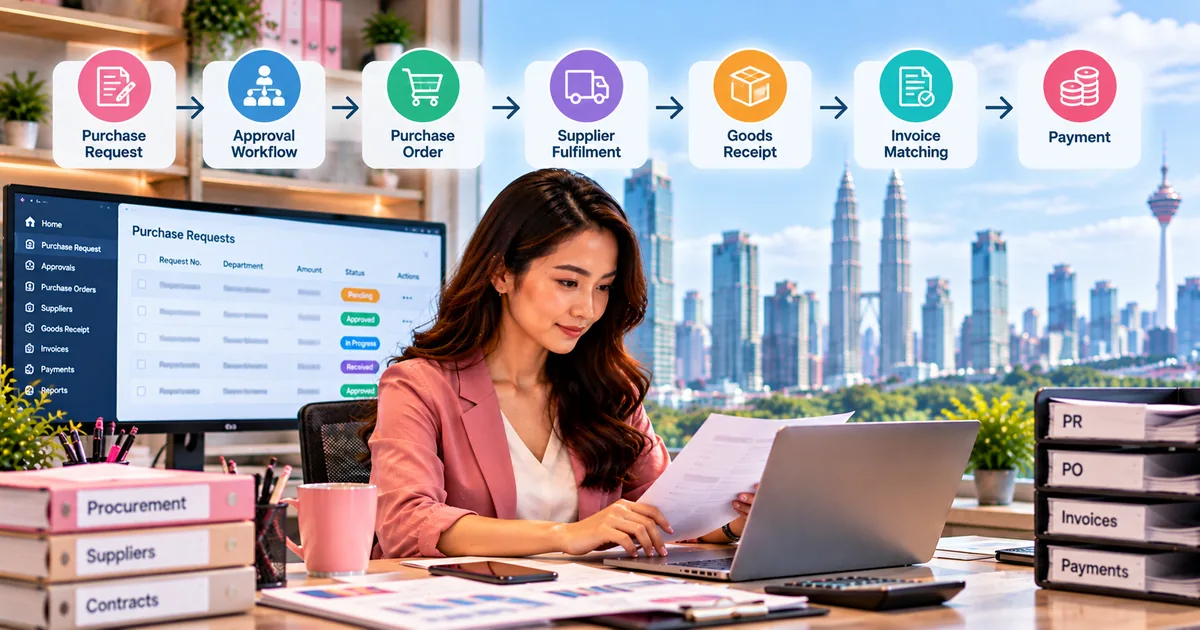
- The Procure-to-Pay Process, Step by Step
- Controls That Make Procurement Software Worth Paying For
- Procurement and LHDN e-Invoicing
- Procurement Software Malaysia: Comparing Your Options
- Rolling Out Procurement Automation
- Next Steps: Mapping Your Purchase-to-Payment Process
- Frequently Asked Questions
What Procurement Software Does for Malaysian Businesses
Procurement software in Malaysia automates the steps from a staff member asking to buy something to the supplier being paid: purchase request, approval, purchase order, goods receipt, supplier bill, matching and payment. Good procurement software Malaysia companies use is not a separate tool but part of the ERP, so every step updates budgets, stock and the accounts at the same time.
Many Malaysian SMEs still run purchasing through WhatsApp messages, email approvals and paper purchase orders, with finance discovering commitments only when the supplier’s invoice arrives. This guide explains what each stage of an automated process should do, the controls that matter, and how LHDN e-invoicing fits in, based on iDynamics’ experience implementing Oracle NetSuite and AutoCount.
Where Manual Purchasing Breaks Down
Manual purchasing works when one person buys everything. Once several departments or branches raise their own purchases, the same problems appear.
- No commitment visibility: finance cannot see what has been ordered until bills arrive, so cash flow forecasts are guesswork.
- Approvals without records: a thumbs-up on WhatsApp is hard to find during an audit.
- Maverick buying: staff buy from whichever supplier they know, ignoring agreed prices and approved vendors.
- Duplicate or wrong payments: the same bill is keyed twice, or a supplier is paid for goods that were never fully delivered.
- Slow month end: accruals for goods received but not yet billed are estimated by hand.
These issues tend to surface at the worst moments: during the annual audit, when a supplier disputes a payment, or when a director asks why a department has spent far more than planned. Procurement software does not remove the need for judgement, but it puts every request, approval and receipt on record so that questions can be answered in minutes.
The Procure-to-Pay Process, Step by Step
A complete procure-to-pay flow has six stages. The software should carry data from one to the next so that nothing is keyed twice.
- Purchase request (requisition): the requester selects items or describes a service, with quantity, estimated cost, department and required date.
- Approval: the request is routed automatically based on amount, department, project or category. Approvers can approve, reject or send back from email or mobile.
- Sourcing and purchase order: buyers convert approved requests into purchase orders, using contract prices or quotations. For larger purchases, a request for quote collects prices from several suppliers.
- Goods or service receipt: the store or requester records what actually arrived, including partial deliveries and rejected items.
- Supplier bill and matching: the bill is checked against the purchase order and the receipt. Differences in price or quantity are flagged before approval.
- Payment: approved bills are scheduled for payment according to terms, and payment files are generated for your bank.
In Oracle NetSuite, this flow is covered by requisitions, approval routing, request for quote, purchase contracts, blanket purchase orders, item receipts, vendor bills with a three-way match approval workflow, and bill payments. AutoCount covers the core purchasing documents, including purchase orders, goods received notes and purchase invoices.
Direct and indirect purchases need different paths
Direct purchases, such as raw materials and stock for resale, usually come from planning or reorder suggestions and go straight to buyers. Indirect purchases, such as office supplies, IT equipment, maintenance and professional services, are raised by staff across the business. A good setup gives each its own route: stock items flow from replenishment to purchase order with minimal approval, while indirect spend goes through requests and budget-based approval. Mixing the two in a single approval chain is a common reason buyers find the new system slow.
Controls That Make Procurement Software Worth Paying For
Approval limits by amount and category
Set clear limits, for example department heads approve up to a set amount, the finance manager above that, and directors for capital purchases. The system enforces the rule every time, including when someone is on leave and a delegate approves.
Three-way match
Three-way match compares the purchase order, the goods receipt and the supplier bill. If the supplier bills more than was ordered or received, or at a higher price, the bill is held for review. In our experience it is one of the most effective controls against overpayment in growing businesses.
Approved suppliers and contract prices
Restrict purchases to approved vendors and pull agreed prices from purchase contracts or blanket purchase orders. Buyers spend less time chasing quotes, and finance can see whether negotiated prices are actually being used.
Budget checks
Linking requests to department or project budgets lets approvers see remaining budget before they approve, rather than finding an overspend at month end.
Segregation of duties
The person who raises a request should not approve it, and the person who sets up a new supplier bank account should not release payments. Role-based permissions make this practical even in a small finance team.
Supplier onboarding and performance
New suppliers should be set up through a short controlled process: registration documents, TIN, bank details verified by a second person, payment terms and tax status. Once suppliers are active, the system can track on-time delivery, quantity and quality issues from receipts and returns. That record makes annual supplier reviews and price negotiations a matter of fact rather than opinion.
Procurement and LHDN e-Invoicing
e-Invoicing changes the supplier bill stage. Once your suppliers are in scope, their invoices are validated by LHDN through MyInvois, and you receive a validated e-invoice rather than only a paper or PDF bill. Your procurement process should check the e-invoice against the purchase order and receipt in the same way as any other bill.
Some purchases require you, as the buyer, to issue a self-billed e-invoice. Examples in LHDN’s guidance include purchases from foreign suppliers and commission payments to agents, dealers or distributors. Our guide to self-billed e-invoices in Malaysia explains the cases, and the LHDN e-Invoice page has the official guidelines.
- Store supplier TINs and registration details in the vendor master so that matching and self-billing work.
- Flag vendors that need self-billed e-invoices, such as overseas suppliers, so that the system prompts the right document.
- Agree who handles a rejected or cancelled supplier e-invoice, and within what time.
- Keep the e-invoice validation reference with the bill for audit.
Procurement Software Malaysia: Comparing Your Options
There are three broad ways to automate purchasing. The right one depends on volume, number of approvers and how closely purchasing must tie to stock and finance.
| Option | Strengths | Watch out for |
|---|---|---|
| Purchasing in accounting software (for example AutoCount) | Simple, local, linked to stock and accounts | Approval workflows may need add-ons as approvers increase |
| Procurement inside a cloud ERP (for example Oracle NetSuite) | Requisitions, routing, contracts, three-way match and payment in one system | Needs proper design of roles and approval rules |
| Standalone procurement tool | Specialised sourcing features | Integration with stock and accounts must be built and maintained |
For most Malaysian SMEs and mid-sized groups, keeping procurement in the same system as inventory and finance avoids the integration work and gives one set of figures. The NetSuite supply chain management page shows how procurement connects with inventory, warehousing and fulfilment.
Reports finance should get from day one
- Open purchase orders by supplier and expected delivery date, for cash flow planning.
- Goods received not yet billed, for month-end accruals.
- Spend by supplier, category and department, compared with budget.
- Bills on hold because of price or quantity differences.
- Ageing of supplier balances and upcoming payments by due date.
Rolling Out Procurement Automation
Procurement projects succeed when the policy is clear before configuration starts. A practical sequence is:
- Write the purchasing policy: who can request, approval limits, when quotes are needed and which suppliers are approved.
- Clean the vendor master: remove duplicates, confirm bank details and add TINs and registration numbers.
- Configure approval rules: start simple, with amount and department, and add categories later.
- Pilot with one department: run real requests for a few weeks and adjust before rolling out company-wide.
- Train requesters and approvers: short sessions focused on their own steps, including mobile approval.
- Review the first month-end: check accruals for goods received not billed and any bills held by matching rules.
Expect some resistance in the first weeks. Requesters may feel the new process is slower than a quick message to the buyer. Keep the request form short, allow approval from a phone, and share how quickly requests are now being approved. Once people see that approvals no longer get lost, adoption usually follows.
If you are also changing ERP, our guide on how to choose an ERP implementer in Malaysia covers what to look for in a partner.
Next Steps: Mapping Your Purchase-to-Payment Process
Take one recent purchase and trace it from the first request to the payment. Note every handover, spreadsheet and approval message along the way. Include the time each step took and who was involved. That map shows exactly where automation will save time and where controls are missing.
iDynamics can walk through that map with you and show how the same purchase would run in Oracle NetSuite or AutoCount. Arrange a free consultation and procurement demo with our team in Petaling Jaya.
Frequently Asked Questions
What is procurement software?
Procurement software automates purchasing from request to payment, covering purchase requests, approvals, purchase orders, goods receipt, supplier bills and payment. When it is part of an ERP, each step also updates stock, budgets and the accounts. This gives finance real-time visibility of commitments and spend.
What is three-way matching in procurement?
Three-way matching compares the purchase order, the goods receipt and the supplier’s bill before the bill is approved for payment. If quantities or prices differ beyond an agreed tolerance, the bill is held for review. It prevents paying for goods that were not ordered or not received.
What is the procure-to-pay process?
Procure-to-pay is the full purchasing cycle from identifying a need to paying the supplier. It usually includes requisition, approval, purchase order, receipt, invoice matching and payment. Automating it reduces manual entry, speeds up approvals and strengthens controls.
Do I need to issue self-billed e-invoices for purchases in Malaysia?
In certain cases defined by LHDN, the buyer must issue a self-billed e-invoice, for example for purchases from foreign suppliers or commission payments to agents and dealers. This applies only if your business is within the scope of e-invoicing. Check the current LHDN e-invoice guidelines for the full list of situations.
Can AutoCount handle purchase orders and goods receipt?
Yes, AutoCount includes purchasing documents such as purchase orders, goods received notes and purchase invoices, linked to stock and accounts. Businesses that need multi-level approval routing, purchase contracts and three-way match workflows across several entities often look at Oracle NetSuite. iDynamics implements both and can advise which fits.

Stephanie Chong
Stephanie writes about Malaysia’s e-invoicing, SST, tax codes, and accounting system readiness for SMEs. At iDynamics Asia, their content helps business owners and finance teams understand LHDN requirements, prepare their accounting software, and avoid common setup mistakes when managing tax-related business processes.
Expertise Areas:
Malaysia e-invoicing, LHDN e-invoice readiness, MyInvois, SST, tax codes, self-billed e-invoices, invoice consolidation, accounting system setup, SME finance operations.