📌 Key Takeaways
- What it does: Supply chain management software plans demand and supply, manages procurement, tracks inventory across locations and runs order fulfilment from one set of data.
- ERP-based or standalone: SCM inside an ERP such as Oracle NetSuite links every purchase, stock movement and shipment to the general ledger, while standalone tools need integrations.
- Planning is the payoff: NetSuite Demand Planning projects demand using methods such as moving average, linear regression and seasonal average, then suggests purchase and work orders.
- Malaysian specifics: Importers, exporters and manufacturers need multi-currency, SST handling and e-invoicing, including self-billed e-invoices where purchases from foreign suppliers require them.
- Cost depends on scope: Pricing is driven by users, modules, locations, integrations and implementation effort, so compare scoped quotes rather than list prices.
Table of Contents
- What Is Supply Chain Management Software?
- Signs Your Business Needs Supply Chain Software
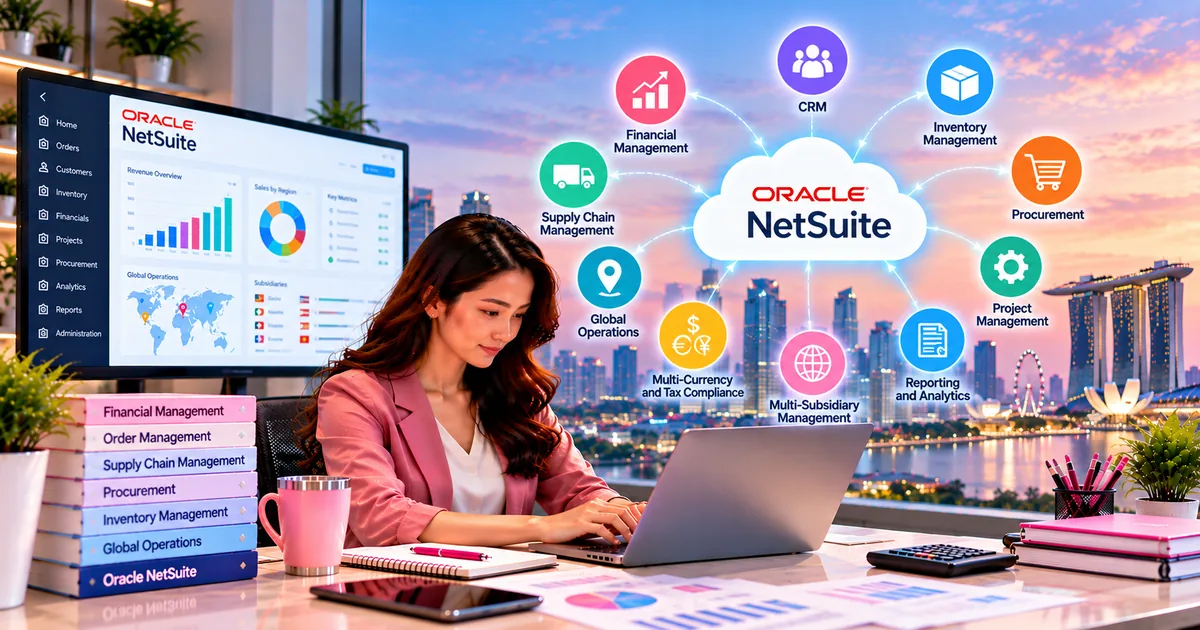
- Core Features of Supply Chain Management Software
- Supply Chain Requirements Specific to Malaysia
- ERP-Based vs Standalone Supply Chain Management Software
- A Malaysian Example: Hai Soon Leong
- Supply Chain Management Software Costs in Malaysia
- How to Choose Supply Chain Management Software
- Next Steps: Plan Your Supply Chain System
- Frequently Asked Questions
What Is Supply Chain Management Software?
Supply chain management software is a system that plans, executes and tracks the flow of goods from suppliers to customers, covering demand planning, procurement, inventory, manufacturing, warehousing and order fulfilment in one place. For Malaysian distributors, manufacturers and retailers, its main value is replacing spreadsheet planning and disconnected tools with one view of what you have, what you need and what you have promised to customers.
The software can be a standalone application or part of an ERP. In an ERP such as Oracle NetSuite, supply chain functions share a database with finance, so every purchase order, stock movement and shipment updates costs and inventory values automatically. This guide explains the core features, the Malaysian requirements to plan for, what drives cost, and how to choose a platform that fits your operation.
Signs Your Business Needs Supply Chain Software
Most businesses do not buy supply chain software because of one event. It is usually a build-up of daily friction. Common signs in Malaysian companies include:
- Stock-outs and overstock at the same time, because reordering is based on gut feel rather than demand history and lead times.
- Purchasing spread across email and spreadsheets, with no clear view of open orders, supplier performance or committed spend.
- Several warehouses or outlets with different stock figures, and transfers between them that are not recorded promptly.
- Production schedules built by hand, so material shortages are discovered on the shop floor.
- Management reports assembled manually from accounting, inventory and sales systems, and already out of date when they arrive.
If three or more of these sound familiar, the cost of the current set-up is probably higher than it looks. The hidden costs include cash tied up in slow-moving stock, urgent freight to cover shortages, lost sales when popular items run out, and senior staff time spent reconciling numbers instead of managing suppliers and customers.
Core Features of Supply Chain Management Software
Feature names vary by vendor. The table below uses the capabilities Oracle NetSuite describes for supply chain management as a reference point.
| Feature area | What it covers | Business benefit |
|---|---|---|
| Demand and supply planning | Demand forecasts, reorder points, time-phased planning, material requirements planning | Buy and make the right quantities at the right time |
| Procurement | Requests for quote, blanket purchase orders, purchase contracts, approvals | Better prices, controlled spending and reliable supply |
| Inventory management | Real-time stock by location, transfers, lot and serial tracking | One accurate stock figure across all sites |
| Order management | Order promising, allocation and fulfilment based on inventory availability and business rules | Fewer late or partial deliveries |
| Manufacturing and scheduling | Work orders, finite and infinite capacity scheduling, shop floor recording | Realistic production plans and accurate costing |
| Quality management | Inspection plans, pass or fail criteria, non-conformance reporting | Consistent product quality and audit trails |
| Warehouse management | Mobile receiving, putaway, picking, packing and cycle counts | Faster, more accurate fulfilment |
Demand planning in practice
According to Oracle’s NetSuite Demand Planning documentation, demand can be projected from sales history using methods such as linear regression, moving average and seasonal average, or taken from current opportunities, quotes and sales orders. A supply plan then suggests purchase orders and work orders based on lead times, expected demand and safety stock. In NetSuite, Demand Planning requires the Advanced Inventory Management feature to be enabled.
Supply planning tools
Oracle describes several supply planning tools in NetSuite, each suited to a different kind of business:
- Reorder points create purchase, work or transfer orders when stock falls below a minimum level, which can be calculated from demand history, safety stock and supplier lead times.
- Time-phased planning calculates demand around a known repurchasing cycle, useful when a supplier delivers on set days.
- Material requirements planning balances supply and demand for manufacturers and schedules production against material availability.
- The Supply Planning Workbench lets planners review supply and demand within a plan and adjust it so customers receive complete, on-time orders.
A distributor with steady demand may only need reorder points at first, while a manufacturer with multi-level bills of materials will rely on material requirements planning.
Warehouse execution
Planning only pays off if the warehouse executes accurately. For businesses with high order volumes or many bins, a dedicated NetSuite warehouse management system adds mobile, scan-driven workflows for receiving, picking and counting.
Supply Chain Requirements Specific to Malaysia
Supply chain software built for another market may need significant localisation here. Plan for the following:
- Multi-currency purchasing and sales for imports and exports, with exchange gains and losses posted correctly.
- Landed costs such as freight, insurance and duties added to inventory cost, so margins reflect the true cost of imported goods.
- SST handling on purchases and sales, configured for the goods and services you deal in and checked with your tax adviser.
- e-Invoicing for sales and, where required, self-billed e-invoices. LHDN’s Specific Guideline sets out when Malaysian buyers must issue self-billed e-invoices for purchases from foreign sellers, so importers within scope should check how this applies to their transactions. Our explainer on self-billed e-invoices in Malaysia covers the rules.
- Multiple entities, for groups that run trading, manufacturing and regional subsidiaries and need consolidated reporting.
ERP-Based vs Standalone Supply Chain Management Software
| Factor | SCM within an ERP | Standalone SCM tool |
|---|---|---|
| Link to finance | Native: every transaction posts to the ledger | Through integration with your accounting system |
| Data consistency | One item, supplier and customer master | Masters must be synchronised |
| Depth in niche areas | Broad coverage, extended with modules | Can be deeper in one function, such as transport |
| Reporting | Operational and financial reports from one source | Often needs a separate reporting layer |
| Best fit | Growing distributors, manufacturers and multi-entity groups | Businesses with one specialised gap and a stable core system |
For SMEs with simpler needs, accounting software with strong inventory and purchasing, such as AutoCount, may be enough for now. The tipping point usually comes with multiple warehouses, manufacturing, several entities or a need for forecast-driven purchasing.
A Malaysian Example: Hai Soon Leong
Hai Soon Leong Sdn Bhd, a Selangor-based F&B manufacturer that produces the Mama’s Delights range alongside private-label products, had outgrown a mix of local accounting software, spreadsheets and manual processes. Growing SKU counts, import and export activity and reporting across several business lines meant management was working with numbers reconstructed by hand.
iDynamics implemented Oracle NetSuite with financials, inventory, procurement, sales order management, manufacturing and bill of materials, warehouse and fulfilment, and multi-currency, plus Malaysian localisation including SST. The project ran for roughly seven to nine months from kickoff to go-live. You can read the full Hai Soon Leong NetSuite case study for the implementation phases and results, including faster management reporting and near-real-time inventory visibility.
Supply Chain Management Software Costs in Malaysia
Oracle NetSuite and most other ERP vendors do not publish fixed price lists. NetSuite is licensed on an annual subscription made up of the core platform, optional modules and the number of users, plus a one-time implementation fee. For supply chain projects, the main cost drivers are:
- Modules required, such as demand planning, advanced inventory, manufacturing, quality and warehouse management.
- Number of users across purchasing, warehouse, production and finance.
- Number of locations, subsidiaries and currencies.
- Integrations with e-commerce, logistics providers, POS or supplier portals.
- Data migration, including item masters, bills of materials and open orders.
- Process design, testing and training effort.
Ask for proposals based on the same written scope, and compare total cost over several years rather than first-year licence fees.
How to Choose Supply Chain Management Software
- Define the problem in numbers you track. For example, stock-outs per month, excess stock value, late deliveries or hours spent on purchasing.
- Map your end-to-end flow. From forecast and purchase request to receipt, production, dispatch and invoice.
- Prioritise planning needs. Decide whether you need reorder points, demand forecasts, material requirements planning or all three.
- Check Malaysian compliance. Multi-currency, SST, e-invoicing and self-billed e-invoices for foreign purchases where required.
- Test with your own data. Ask vendors to demonstrate your real scenarios, such as a partial delivery or a multi-level bill of materials.
- Assess the implementation partner. Experience with distribution and manufacturing in Malaysia matters. Our guide on how to choose an ERP implementer in Malaysia sets out what to ask.
A realistic implementation roadmap
Supply chain projects go better in stages than in one big switch. A typical sequence is:
- Foundation: clean item, supplier and customer masters, units of measure and locations, then go live on procurement, inventory and order management.
- Control: add approval workflows, landed costs, lot or serial tracking and warehouse processes once the basics are stable.
- Planning: introduce reorder points, demand plans and supply plans after you have a few months of reliable transaction history in the new system.
- Optimisation: refine safety stock, lead times and planning parameters using real results, and build dashboards for purchasing and operations.
Rushing straight to forecasting before the data is clean is one of the most common reasons planning tools are switched off after go-live.
Next Steps: Plan Your Supply Chain System
Start with the problems costing you the most, whether that is stock accuracy, purchasing control or production planning, and check whether your current system can solve them with better configuration before replacing it. If it cannot, a cloud ERP with built-in supply chain management gives you one source of truth from supplier to customer.
iDynamics implements Oracle NetSuite for Malaysian distributors, retailers and manufacturers. Explore our NetSuite supply chain management solution, or book a free consultation with iDynamics to review your supply chain and see a demonstration based on your own processes.
Frequently Asked Questions
What is supply chain management software used for?
Supply chain management software is used to plan demand and supply, manage purchasing, track inventory across locations, schedule production and fulfil customer orders. It gives businesses one view of stock, orders and suppliers instead of separate spreadsheets.
Is supply chain management part of ERP?
It can be. ERP systems such as Oracle NetSuite include supply chain functions like procurement, inventory, demand planning, manufacturing and order management, all linked to finance. Some businesses use standalone supply chain tools connected to their accounting system instead.
What is the difference between SCM and WMS?
Supply chain management covers the full flow from planning and procurement to fulfilment across the business. A warehouse management system focuses on execution inside the warehouse, such as receiving, putaway, picking, packing and cycle counting.
Does NetSuite have demand planning?
Yes. NetSuite Demand Planning projects demand from sales history using methods such as moving average, linear regression and seasonal average, or from current opportunities, quotes and orders. It then generates supply plans with suggested purchase and work orders, and requires the Advanced Inventory Management feature.
How much does supply chain management software cost in Malaysia?
Cost depends on the modules, number of users, locations, integrations and implementation effort. NetSuite is sold as an annual subscription plus a one-time implementation fee, so the reliable figure comes from a scoped quote from a partner such as iDynamics.

Stephanie Chong
Stephanie writes about Malaysia’s e-invoicing, SST, tax codes, and accounting system readiness for SMEs. At iDynamics Asia, their content helps business owners and finance teams understand LHDN requirements, prepare their accounting software, and avoid common setup mistakes when managing tax-related business processes.
Expertise Areas:
Malaysia e-invoicing, LHDN e-invoice readiness, MyInvois, SST, tax codes, self-billed e-invoices, invoice consolidation, accounting system setup, SME finance operations.